The Remarkable Story of Klimt’s Portrait of Elisabeth Lederer
The Remarkable Story of Klimt’s Portrait of Elisabeth Lederer
In November 2025, Gustav Klimt’s Portrait of Elisabeth Lederer (also known as Bildnis Elisabeth Lederer) made headlines when it sold at Sotheby’s New York for US$236.4 million, becoming one of the most expensive modern artworks ever sold at auction. Beyond the staggering price, the painting embodies a rich tapestry of personal, artistic, and historical significance—intertwining family, cultural exchange, survival, and legacy.
The Lederer Family: Patrons, Collectors, and Friends of the Avant-Garde
The Lederers were among Klimt’s most important patrons in early 20th-century Vienna. Industrialist August Lederer and his wife, Serena Lederer (née Pulitzer), were deeply engaged in Vienna’s cultural life and supported Klimt generously. Serena’s portrait by Klimt, painted in 1899 is on view at The Metropolitan Museum of Art in New York, and earlier, he also painted Elisabeth’s grandmother, Charlotte Pulitzer in 1915.
Together, these three portraits trace a multigenerational lineage, linking family, art, and Vienna’s vibrant cultural world at the turn of the century. Over time, the Lederers assembled what became one of the finest private collections of Klimt’s work, reflecting both their deep appreciation for his art and their close personal connection to the artist.
Elisabeth’s brother, Erich Lederer, was also a notable figure in Vienna’s artistic circles. A friend of Egon Schiele, he even posed for the artist, further cementing the family’s close ties to the leading avant-garde artists of their time.
Serena Pulitzer Lederer (1867–1943), by Gustav Klimt, 1899, MET, New York
The Portrait of Elisabeth Lederer: A Masterpiece of Elegance, Symbolism, and Cross-Cultural Influence
Painted between 1914 and 1916, the Portrait of Elisabeth Lederer depicts the young woman draped in a white, intricately patterned robe, rendered in Klimt’s signature decorative style. Elisabeth is presented with a subtle, enigmatic gaze, standing against a densely ornamented backdrop.
What makes this work especially striking is its integration of Asian art influences, a hallmark of Klimt’s mature style. According to art historian Emily Braun, the background includes figures derived from Chinese material culture and Peking opera, including low-ranking military types, scholar figures, and female attendants, rendered as part of a narrative scene. Art historian and expert in Viennese art Tobias G. Natter observes that these figures “resemble figures from a dream … this mood is echoed by the ornamental field rising behind Elisabeth’s figure.”
The decorative motifs of the robe and background also draw on Oriental ceramics, a source of inspiration for other Klimt portraits of the period, such as Portrait of Adele Bloch-Bauer II and Portrait of Friederike Maria Beer. The flattened, stylized forms, rhythmic repetition merges Eastern aesthetics with Western portraiture in a sophisticated, cosmopolitan synthesis. The painting operates on multiple levels: Elisabeth is a lifelike figure and simultaneously part of a symbolic, ornamental universe.
Portrait of Elisabeth Lederer, 1914-1916, Gustav Klimt, Sold at Sotheby's New York, November 18, 2025
Serena Lederer in her Vienna apartment, behind her Gustav Klimt's 1914–1916 Portrait of Elisabeth Lederer, c. 1930
Surviving the Nazi Era
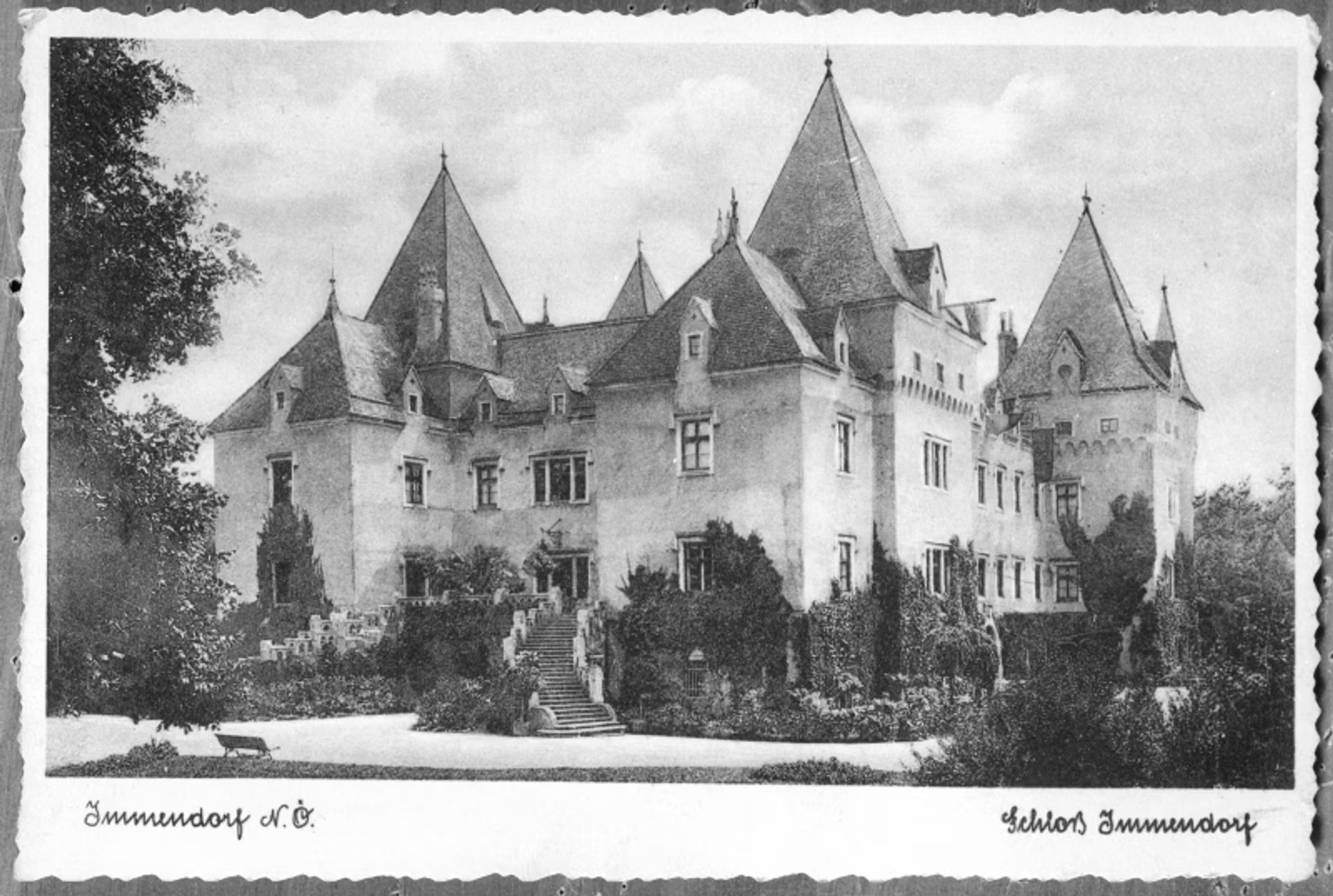
Following the Anschluss in 1938, the painting was seized by authorities in Vienna. Remarkably, it survived the war unscathed despite nearly being destroyed. Most of the Lederer family’s art collection was lost in 1945, when retreating German forces set fire to Immendorf Castle, where works had been stored to protect them from Soviet capture. Fifteen Klimt paintings were destroyed in that blaze.
Other works by Klimt were stored at the shipping company Kirchner & Co. in Vienna, and several were later included in the 1943 Vienna Secession exhibition, organized at the request of Baldur von Schirach, highlighting the complex and sometimes contradictory treatment of looted or “degenerate” art under the Nazi regime.
The Portrait of Elisabeth Lederer and other family portraits were spared because, under Nazi regulations, portraits of Jewish sitters were considered of little value. These works were not sent to Immendorf Castle and thus avoided destruction. After the war, the paintings surfaced on the art market at a sale at the Viennese auction house Dorotheum. The sale was abandoned, and the works were ultimately returned to Erich Lederer, Elisabeth’s brother, who kept the painting until 1983, when he sold it to art dealer Serge Sabarsky.
A Life and Identity Intertwined with Art
Elisabeth’s portrait carries a personal history of survival. During the Nazi period, Elisabeth reportedly claimed that Klimt was her biological father. This unusual assertion, supported by documentation, offered her some protection under Nazi racial laws, allowing her to remain in Vienna until her death in 1944. The painting thus embodies not only artistic achievement but also resilience and the complex ways in which identity and art can intersect in life-or-death circumstances.